
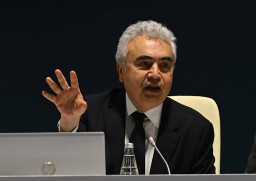
The Iran war has created the most dangerous period for global energy security since the Cold War, when superpower confrontation posed existential threats to critical energy infrastructure and supply routes, the head of the International Energy Agency has warned. Fatih Birol, speaking in Canberra, said the weaponization of energy supply — through attacks on Gulf infrastructure and the closure of the Hormuz strait — had introduced a level of geopolitical risk into global energy markets that had not been seen in decades. He described the resulting crisis as equivalent to the combined force of the 1970s twin oil shocks and the Ukraine gas emergency.
Birol said that during the Cold War, the primary energy security threat had been the potential for superpower conflict to disrupt access to energy resources. That threat had largely receded with the end of the Cold War, only to be replaced by new forms of energy insecurity driven by regional conflicts in major producing areas. The Ukraine conflict had been a harbinger; the Iran crisis had confirmed that energy weaponization in regional conflicts was now a major and recurring strategic threat.
The conflict began February 28 with US and Israeli strikes on Iran and has since removed 11 million barrels of oil per day and 140 billion cubic metres of gas from world markets. At least 40 Gulf energy assets have been severely damaged, and the Hormuz strait — through which approximately 20 percent of global oil flows — remains closed. The IEA deployed 400 million barrels from strategic reserves on March 11 in its largest emergency action.
Birol confirmed further releases were under consideration and said the IEA was consulting with governments across Europe, Asia, and North America. He called for demand-side policies including remote work, lower speed limits, and reduced commercial aviation. He met with Australian Prime Minister Anthony Albanese and said the geopolitical energy security challenges of the current period demanded responses with Cold War-era strategic seriousness.
Trump’s 48-hour ultimatum to Iran to reopen the strait expired without result, and Tehran threatened retaliatory strikes on US and allied energy and water infrastructure. Birol concluded that the most dangerous period for global energy since the Cold War demanded a response that matched the seriousness of the challenge. He called for the kind of strategic commitment, investment, and international coordination that the Cold War era had produced — adapted to the twenty-first-century energy security environment.